Milena Dopitová
Hair Salon
Artist
Milena Dopitová
(1963 - ), Czech
Original Title
Nepočítám se svou proměnou II
Date1993
Classificationsphotograph
Credit LineKunsthalle Praha
DescriptionMilena Dopitová is an important multi-media artist from the Czech artist generation of the 1990s, associated with the rise of prominent women artists. Her work is especially concerned with identity, both her own and that of others. She gained international recognition following a series of international exhibitions, the first of which was her participation in the Aperto ’93 exhibition at the Venice Biennale in 1993. Dopitová’s early career was linked to the art group Pondělí (Monday; 1989–1993), where she was the only woman member alongside male artists Pavel Humhal, Petr Lysáček, Michal Nesázal, Petr Písařík, and Petr Zubka. The group’s programmatic aim centred on capturing the authentic experience of the surrounding world, and members also shared an interest in the topic of everydayness. Their generation of artists ushered in a focus on investigating themes through a range of mediums (object, sculpture, photograph, moving image, music) and exploring their mutual intersection through monumental spatial installations. A characteristic feature of Dopitová’s work is a constant oscillation between the conceptual and the intuitive, which art theorist Martina Pachmanová has termed “emotional conceptualism”. Even her early work demonstrates an intuitive connection with topics linked to gender and feminism, frequently using handicrafts (such as crocheting) and specific materials (wool, textile) to explore these themes. These traditionally feminine elements represent a counterpoint to the more traditionally masculine materials Dopitová has worked with in other installations, which evidence her ability to also empathetically engage with the male world and its topics. Within the sphere of women’s issues, her work gradually evolved toward a more deliberate engagement with feminism, delving into themes of intimacy, eroticism, motherhood, exploring one’s body, and the role of women within the structures of contemporary society. Dopitová’s projects examine the theme of identity from multiple perspectives—social, bodily, and gender identity—while also examining the boundaries between “me” and “you” through the lens of her relationship with her twin sister. Some of her projects have aimed to highlight the positive aspects of old age, portraying it as “a guide on the journey to deepening one’s wisdom, spirituality, and dignity”. Dopitová is also interested in more general topics, such as interpersonal relations, memory, transience, beauty, and positive human values. In her most recent projects, she has explored questions such as the sustainability of cultural, national, and ethnic identities, cultural exchange, human memory, the superficiality of contemporary society, and the instability of the today’s world. Her work is infused with general sense of ambivalence: although she maintains a degree of distance from it, it is also subtly shaped by her own personal experiences and authentic feelings. Subsequently, while multiple layers of meaning can often be deciphered in Dopitová’s work, it also retains a cohesive unity as an artistic whole, with both aesthetic and emotional effect. Ambivalence is also characteristic of the title she chooses for artworks and exhibitions.
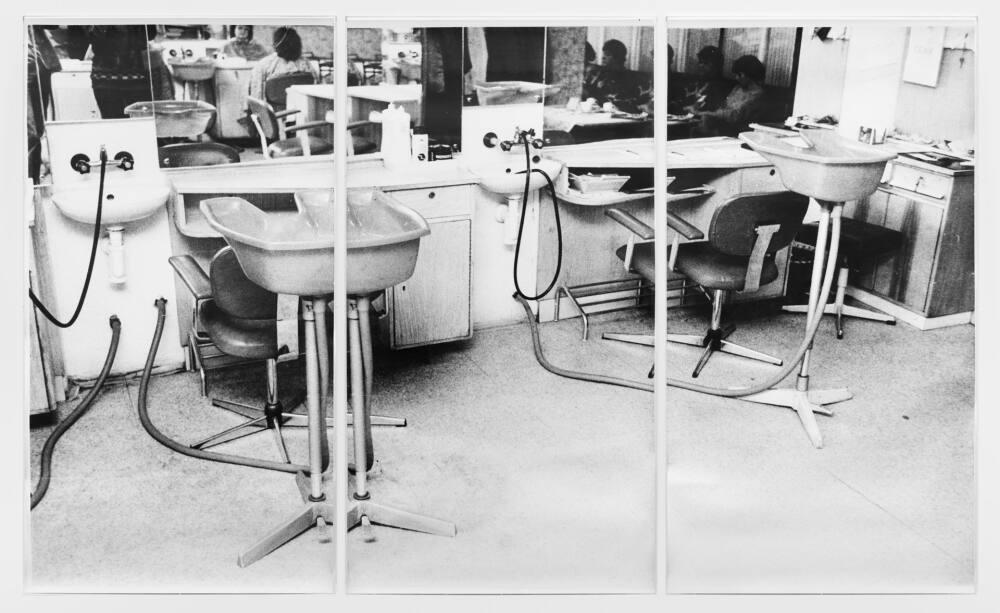
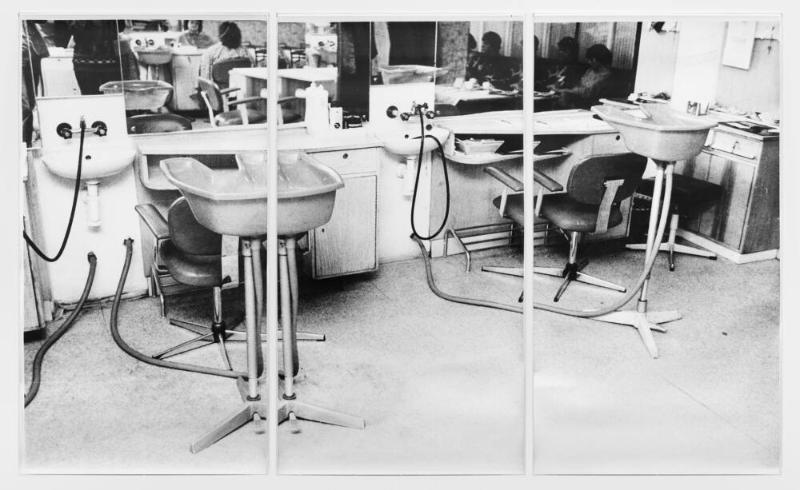
This early photographic installation titled I Don’t Expect My Transformation II (1993), explores the theme of social intimacy. The monumental photographic triptych depicts the interior of a hair salon in a typical post-socialist style. Intended to offer customers refinement of their appearance, the space itself appears to lack any consideration for its aesthetic qualities. Shortly before creating this work, Dopitová visited the USA and witnessed its obsessive cult of the body and consumer society, which were already beginning to influence the Czech context. An engaging aspect of this work is the contrast between the technical, mechanic space of the hair salon and the subtle human presence, which is only hinted at by the reflection in the mirror. The photograph also captures the typical post-socialist appearance of these beauty salons. It was taken at the very end of the Pondělí art group’s existence and reflects Dopitová’s characteristic engagement with everyday life and her own identity, as well as her sense of irony, conceptualism, and the social dimension of art. I Don’t Expect My Transformation II is part of a larger cycle of works in which Dopitová explores hygiene and the idea of improving our bodies. As suggested by its title, the work thematizes the myopia and superficiality of the transformations that such spaces and services provide. In the context of Dopitová’s early work, this piece explores themes typical of her work at the time (referencing themes such as the human body, hygiene, beautification, transformation, the woman’s world and its obsession with physical beauty) and demonstrates her gradual evolution from photography to spatial installation. The broader series includes a sonic-object installation consisting of four hooded hair dryers, each covered with fabrics typically used in hair salons. Dopitová was intrigued by the ways some of these beauty machines resemble torture machines in which women must sit motionlessly. Both the photographic triptych and the installation were exhibited together as part of her 1999 exhibition Installations 1992–1999 at the House of Arts Brno. Analogue photography and its traditional developing process played an important role in Dopitová’s work during the first half of the 1990s (in: Olga Malá, Milena Dopitová, GHMP, Prague 1995, np.), also helping her perceive her own appearance and identity. More generally, this artwork demonstrates the topicality of photography in Czech art during the 1990s. Dopitová aligned herself with a group of artists who positioned themselves as “non-photographers”, lacking formal photographic education and regard for conventional photographic criteria. Their approach corresponded with the greater trend of blending artistic and non-artistic visual styles.
Conceptual artist Milena Dopitová (born 1963, Šternberk) is part of a group of prominent post-revolution artists who began their studies before the Velvet Revolution. However, the most formative period of Dopitová’s early artistic journey occurred during her post-revolution studies in Milan Knížák’s intermedia studio (1989 –1994) at the Academy of Fine Arts in Prague. Eventually becoming a teacher herself, Dopitová has taught at the Academy of Arts, Architecture and Design in Prague and the University of West Bohemia in Pilsen; she is currently head of the intermedia studio at the Academy of Fine Arts in Prague. She first became active in the Czech art scene with the art group Pondělí (Monday) and through her participation in the exhibition Nové intimity (New Intimacies; Exhibition Hall of the Centre for Folk Art Production, Prague, 1991). Her first solo exhibition took place the following year (1992) at the Václav Špála Gallery in Prague. One year later, her work was featured in the international exhibition Women’s Art at the Old Town Hall in Prague (1993). These exhibitions propelled Dopitová toward wider recognition, leading to her participation in international events and exhibitions such as the Biennale of Sydney (1992), the São Paulo Art Biennial (1992), the Aperto ’93 exhibition at the Venice Biennale (1993), Milena Dopitová in Context at the ICA in Boston (1994), Urbane Legenden, Staatliche Kunsthalle Baden-Baden (1996), Global Feminism: New Directions in Contemporary Art, Brooklyn Museum, New York (2007), and Behind the Velvet Curtain: Seven Woman Artists from the Czech Republic, Washington (2009). In recent years, Dopitová has had several solo exhibitions, such as I’ll Stay a Little Longer (Moravian Gallery in Brno, 2011), Next Time at Your Place (MeetFactory, Prague, 2019), The Next Stop is a Request Stop (House of Arts Brno, 2022), Even Odd (Bozar - Centre for Fine Arts, Brussels; National Gallery – Trade Fair Palace, Prague; 2023). She is also the holder of several important awards: the Central European Culture Initiative, Vienna, 1997; the Pollock-Krasner Foundation, New York, 1997; the Tranzit Contemporary Art Initiative Development Award, Prague, 2003; and the Michal Ranný Award, Brno, 2010. Throughout her career, and especially during the 1990s, Dopitová received numerous grants, scholarships, and artist residencies (such as the International Studio and Curatorial Program, New York, 2002; MAK Artists and Architects-in-Residence Program, Los Angeles, 1997; The Sculpture Space, Utica New York, 1996). Her work is featured in numerous Czech (National Gallery Prague, Prague City Gallery, Moravian Gallery in Brno) and international museum collections (Brooklyn Museum, New York; Kontakt – The Art Collection of Erste Group and Erste Foundation, Vienna; Carnegie Museum of Art, Pittsburgh; Kunstforum Ostdeutsche Galerie, Regensburg). Her work has been exhibited at prestigious institutions in the Czech Republic and abroad, for instance at the Moravian Gallery in Brno, the Brooklyn Museum in New York, Akademie der Künste in Berlin, Whitechapel Gallery in London, the Museum of Contemporary Art in Helsinki, and Artists Space in New York.
This early photographic installation titled I Don’t Expect My Transformation II (1993), explores the theme of social intimacy. The monumental photographic triptych depicts the interior of a hair salon in a typical post-socialist style. Intended to offer customers refinement of their appearance, the space itself appears to lack any consideration for its aesthetic qualities. Shortly before creating this work, Dopitová visited the USA and witnessed its obsessive cult of the body and consumer society, which were already beginning to influence the Czech context. An engaging aspect of this work is the contrast between the technical, mechanic space of the hair salon and the subtle human presence, which is only hinted at by the reflection in the mirror. The photograph also captures the typical post-socialist appearance of these beauty salons. It was taken at the very end of the Pondělí art group’s existence and reflects Dopitová’s characteristic engagement with everyday life and her own identity, as well as her sense of irony, conceptualism, and the social dimension of art. I Don’t Expect My Transformation II is part of a larger cycle of works in which Dopitová explores hygiene and the idea of improving our bodies. As suggested by its title, the work thematizes the myopia and superficiality of the transformations that such spaces and services provide. In the context of Dopitová’s early work, this piece explores themes typical of her work at the time (referencing themes such as the human body, hygiene, beautification, transformation, the woman’s world and its obsession with physical beauty) and demonstrates her gradual evolution from photography to spatial installation. The broader series includes a sonic-object installation consisting of four hooded hair dryers, each covered with fabrics typically used in hair salons. Dopitová was intrigued by the ways some of these beauty machines resemble torture machines in which women must sit motionlessly. Both the photographic triptych and the installation were exhibited together as part of her 1999 exhibition Installations 1992–1999 at the House of Arts Brno. Analogue photography and its traditional developing process played an important role in Dopitová’s work during the first half of the 1990s (in: Olga Malá, Milena Dopitová, GHMP, Prague 1995, np.), also helping her perceive her own appearance and identity. More generally, this artwork demonstrates the topicality of photography in Czech art during the 1990s. Dopitová aligned herself with a group of artists who positioned themselves as “non-photographers”, lacking formal photographic education and regard for conventional photographic criteria. Their approach corresponded with the greater trend of blending artistic and non-artistic visual styles.
Conceptual artist Milena Dopitová (born 1963, Šternberk) is part of a group of prominent post-revolution artists who began their studies before the Velvet Revolution. However, the most formative period of Dopitová’s early artistic journey occurred during her post-revolution studies in Milan Knížák’s intermedia studio (1989 –1994) at the Academy of Fine Arts in Prague. Eventually becoming a teacher herself, Dopitová has taught at the Academy of Arts, Architecture and Design in Prague and the University of West Bohemia in Pilsen; she is currently head of the intermedia studio at the Academy of Fine Arts in Prague. She first became active in the Czech art scene with the art group Pondělí (Monday) and through her participation in the exhibition Nové intimity (New Intimacies; Exhibition Hall of the Centre for Folk Art Production, Prague, 1991). Her first solo exhibition took place the following year (1992) at the Václav Špála Gallery in Prague. One year later, her work was featured in the international exhibition Women’s Art at the Old Town Hall in Prague (1993). These exhibitions propelled Dopitová toward wider recognition, leading to her participation in international events and exhibitions such as the Biennale of Sydney (1992), the São Paulo Art Biennial (1992), the Aperto ’93 exhibition at the Venice Biennale (1993), Milena Dopitová in Context at the ICA in Boston (1994), Urbane Legenden, Staatliche Kunsthalle Baden-Baden (1996), Global Feminism: New Directions in Contemporary Art, Brooklyn Museum, New York (2007), and Behind the Velvet Curtain: Seven Woman Artists from the Czech Republic, Washington (2009). In recent years, Dopitová has had several solo exhibitions, such as I’ll Stay a Little Longer (Moravian Gallery in Brno, 2011), Next Time at Your Place (MeetFactory, Prague, 2019), The Next Stop is a Request Stop (House of Arts Brno, 2022), Even Odd (Bozar - Centre for Fine Arts, Brussels; National Gallery – Trade Fair Palace, Prague; 2023). She is also the holder of several important awards: the Central European Culture Initiative, Vienna, 1997; the Pollock-Krasner Foundation, New York, 1997; the Tranzit Contemporary Art Initiative Development Award, Prague, 2003; and the Michal Ranný Award, Brno, 2010. Throughout her career, and especially during the 1990s, Dopitová received numerous grants, scholarships, and artist residencies (such as the International Studio and Curatorial Program, New York, 2002; MAK Artists and Architects-in-Residence Program, Los Angeles, 1997; The Sculpture Space, Utica New York, 1996). Her work is featured in numerous Czech (National Gallery Prague, Prague City Gallery, Moravian Gallery in Brno) and international museum collections (Brooklyn Museum, New York; Kontakt – The Art Collection of Erste Group and Erste Foundation, Vienna; Carnegie Museum of Art, Pittsburgh; Kunstforum Ostdeutsche Galerie, Regensburg). Her work has been exhibited at prestigious institutions in the Czech Republic and abroad, for instance at the Moravian Gallery in Brno, the Brooklyn Museum in New York, Akademie der Künste in Berlin, Whitechapel Gallery in London, the Museum of Contemporary Art in Helsinki, and Artists Space in New York.